Sign board manufacturer in Musaffah. That is not a slogan. That is the address where the sparks actually fly.
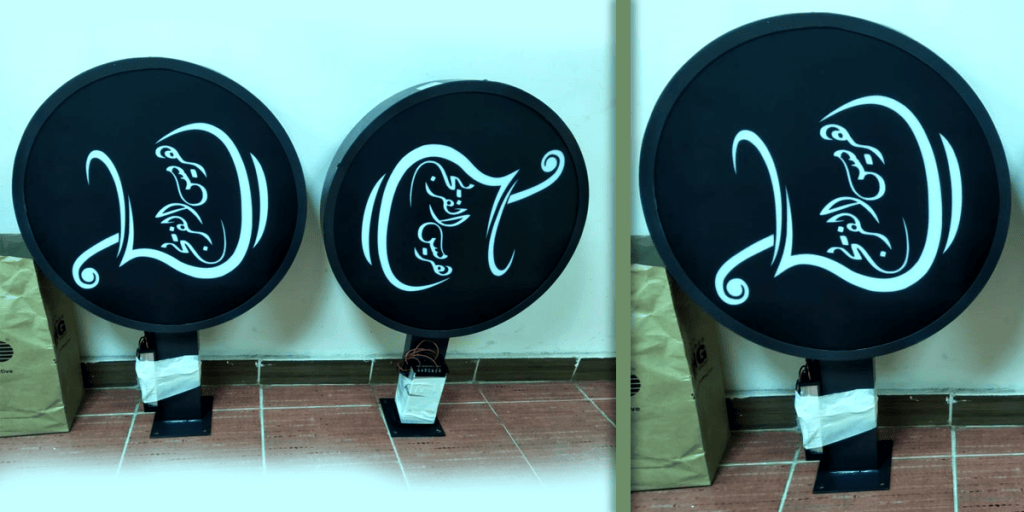
I am writing this from our workshop, and if you walked in right now you would hear the CNC router cutting an acrylic face, smell fresh powder coating curing on a pole, and see two round lightboxes sitting on the floor waiting for their final burn-in test before they go out on a truck. That is an ordinary Tuesday for us at Point to Point Advertising Designs — from our facility in Musaffah 39 to our office in Musaffah 36, we design, cut, weld, wire, finish and install signage in-house for businesses right across Abu Dhabi and the UAE.
No middlemen. No guesswork. No “we will get it made somewhere and hope it comes back right.” Just tight fabrication and lighting that still looks sharp at 11 o’clock at night.
This post is the long version of what I normally explain to a customer over a coffee: what we make, how a sign is actually built, what the approvals look like in Abu Dhabi, which materials survive our summers, what drives the price up or down, and the mistakes that cost people money. If you are planning a sign for your shop, clinic, restaurant, office or fleet — grab a coffee yourself. This is everything.
Why “manufactured in Musaffah” actually matters to you
There are two kinds of signage companies in the UAE. There are traders — they take your enquiry, send it to a workshop, add a margin, and forward you whatever comes back. And there are manufacturers — the people who own the router, the welding bay, the paint booth and the installation truck.
We are the second kind, and the difference shows up in four very practical places:
- Speed. When a job is in our own bay, a change is a conversation across the floor, not an email chain across three companies. Urgent shop-opening deadlines are survivable.
- Quality control. We see every weld, every seam, every LED module before it is closed up. A sign is easy to make look good on day one; the hard part is making it look good in year three.
- Honest pricing. You are paying for material, labour, machine time and installation — not for a chain of people passing the file along.
- Accountability after handover. If a driver reverses into your pylon or a module fails, you call the people who built it. We still have your drawings.
Musaffah is also simply the right place to be. It is Abu Dhabi’s industrial heart — steel, aluminium, acrylic, powder coating, electrical supplies and transport are all within a few minutes of our door. That proximity is why we can quote realistically and deliver on the date we promised.
What we manufacture
1. LED lightboxes
Single-sided, double-sided, square, rectangular, circular, shaped-to-logo, wall-mounted, projecting or pole-mounted. This is our bread and butter and the most requested item for shops, pharmacies, clinics, salons and cafes.
2. 3D built-up letters and logos
Acrylic front-lit letters, stainless steel letters, aluminium letters, halo-lit (back-lit) letters that throw a glow onto the wall behind them, and non-illuminated built-up letters for interiors. The look you see on good shopfronts along Hamdan Street and inside the malls.
3. Shopfronts and fascia signage
Complete fascia cladding, ACP panelling, frame and sub-structure, illuminated or non-illuminated — designed to sit correctly inside the landlord’s and the authority’s rules for your building.
4. Office and interior signage
Reception logo walls, door and desk nameplates, wayfinding and directional systems, floor numbering, glass frosting and manifestation, acrylic standoff plaques, engraved and etched plates.
5. Pylon signs, totems and free-standing units
Fabricated steel structure, welded and galvanised, powder-coated, illuminated faces — for showrooms, service stations, industrial premises and compounds.
6. Safety, statutory and industrial signage
Site boards, safety and mandatory signage, traffic and road signage, bollards, parking and directional plates. Our sister unit, Point to Point Metal Industries, handles the heavier metal side of this, including bollards manufactured to ADNOC specification.
7. Vehicle and fleet branding
Full wraps, partial wraps, cut-vinyl lettering, van and truck branding, magnetic panels. A branded fleet is the cheapest advertising a small business will ever buy — the vans are already driving around.
8. Digital printing and finishing
Flex and vinyl printing, roll-ups, pull-up banners, backdrops, UV DTF printing, etching and engraving, and LED screens.
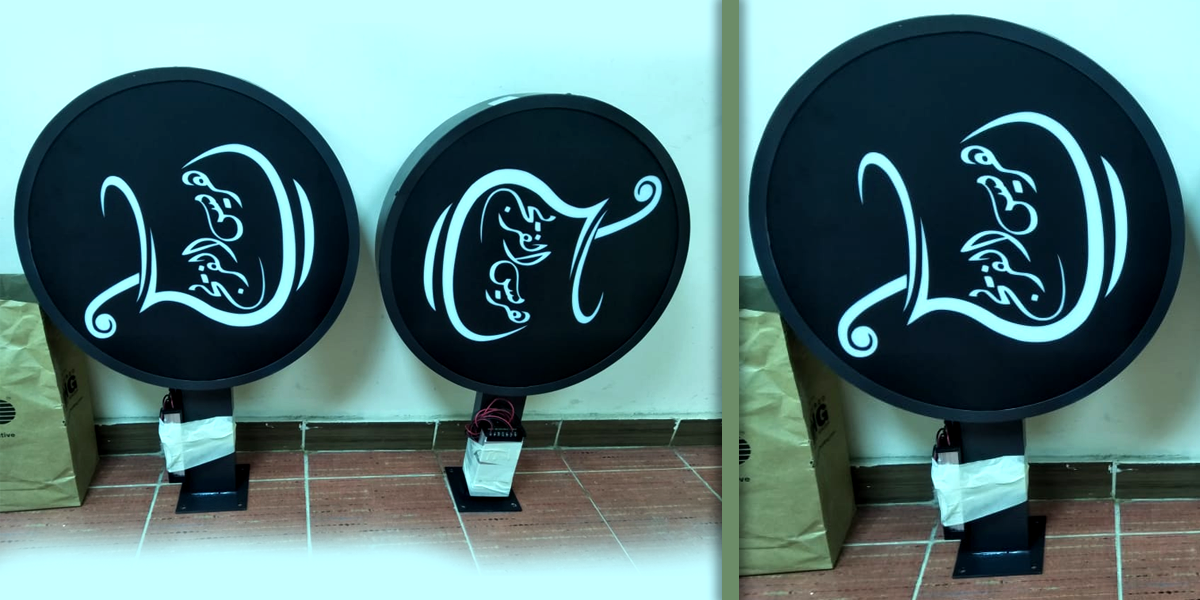
Anatomy of a round lightbox: what is actually inside the sign in that photo
People see a black circle with glowing Arabic calligraphy. Here is what it is made of, layer by layer — and why each choice matters.
- The return (the side wall). Rolled aluminium or ACP, formed into a true circle. A cheap lightbox gives itself away here: you see flat spots and a visible joint. We roll it properly and hide the seam.
- The back pan and internal frame. Aluminium or GI, with a frame stiff enough that the face cannot bow in the heat. Heat is the enemy of every flat panel in this country.
- The face. Opal (milky) acrylic, typically 3 mm, chosen because it diffuses light evenly. If you light a clear panel you get hot spots — bright dots where each LED sits. Opal acrylic is what gives you that smooth, even glow.
- The graphics. Black translucent vinyl applied over the face, with the calligraphy cut out so only the letters light up. The alternative is a routed face with acrylic letters pushed through. Both are valid; the vinyl method is faster and easier to update if you rebrand.
- The LEDs. High-brightness SMD modules on an aluminium backing, spaced and rowed according to the depth of the box. Spacing is a calculation, not a guess — too far apart and you get shadows, too close and you waste power and generate heat.
- The driver / power supply. A constant-voltage LED driver, sized with headroom rather than run at 100% of its rating, and housed in an IP-rated enclosure. Most “my sign stopped working” calls in the UAE are a failed driver or moisture in the driver box — not failed LEDs.
- Gaskets, drainage and cable entry. Sealed where water can get in, and drained where condensation forms. Yes, it rains here — and when it does, it tests every sign in the city at once.
- The pole and base plate. Welded MS section, powder-coated, sitting on a base plate with anchor bolts. For outdoor pole signs we design for wind load, not just for looks.
A note on Arabic calligraphy, because it deserves one
Arabic script is unforgiving in signage. The connections between letters, the thickness transitions in a swash, the balance of a long tail — these details are what make a piece look either beautifully done or slightly wrong. When we cut a piece like the one in the photo, the curves are vectorised and checked at full size before a single sheet is touched, because a curve that looks fine on a laptop can look clumsy at 900 mm diameter. If your brand carries an Arabic name, insist that whoever makes your sign treats the calligraphy as artwork, not as clipart.
How a signage project runs with us, step by step
- Enquiry and site survey. You send a photo, a location and rough dimensions — or we come and measure. We check the wall, the fascia, the power point, the access and the mounting surface. Surveys prevent surprises.
- Concept and visual mock-up. We superimpose the proposed sign onto a photo of your actual building so you can see it before you commit to it. This is where most changes should happen — they are free at this stage.
- Quotation. Itemised: material, size, illumination type, fabrication, installation, and anything excluded. You should always be able to see what you are paying for.
- Approvals and permits. Landlord or mall approval, and the municipality permit where one is required. More on this below.
- Shop drawings and material approval. For contractor and government projects we issue technical submittals, material data sheets and, where required, certificates of conformity and origin declarations.
- Fabrication. Cutting, forming, welding, painting, wiring, assembly and a full burn-in test with the sign switched on in the workshop for hours before it leaves.
- Installation. Our own team, our own tools, scheduled around your trading hours where we can.
- Handover and after-care. Photos, warranty, and a maintenance arrangement if you want one.
Signage approvals in Abu Dhabi: the short, honest version
This is the part that worries first-time customers the most, and it is genuinely the part where a local manufacturer saves you weeks.
In broad terms, outdoor signage in Abu Dhabi is regulated — a permit is normally required before a shopfront or outdoor sign goes up, and the application goes through the relevant municipality under the Department of Municipalities and Transport. The recurring themes you should plan for are these:
- Your sign must match your trade licence. The name on the fascia should be the name on the licence. If you trade under a shorter version, that has to be dealt with, not ignored.
- Arabic is expected. Signage is generally required to carry Arabic, and Arabic is usually expected to be given prominence. Design for it from the start rather than squeezing it in at the end.
- Size and position are governed by the building, not by your preference. Fascia zones, projections over pavements and illumination types all have limits.
- Landlord or mall approval usually comes first. Many malls and towers have their own signage manual that is stricter than the authority’s rules.
- Documents take time. Trade licence, tenancy contract, building photographs, dimensioned drawings and the visual are the usual pack.
Rules and fees do change, and they differ between Abu Dhabi, Al Ain, Al Dhafra and the Dubai emirate, so treat the above as orientation rather than gospel — we check the current requirement for your specific building before you spend anything. We handle permit services as part of our work, which is the single most common reason customers come back to us for their second branch.
Choosing materials for a UAE climate
A sign in Abu Dhabi has to survive roughly 50 °C surface heat, heavy UV, coastal humidity, salt in the air, fine dust that gets into everything, and the occasional serious downpour. Here is how the common materials behave.
- Acrylic (PMMA). Excellent light diffusion, holds colour, machines beautifully. It is the correct face material for illuminated signage. It is not the correct material for something that will be knocked — it is brittle.
- ACP (aluminium composite panel). Light, flat, cost-effective, great for fascia and returns. Quality varies enormously between brands; a thin, soft-core panel will oil-can and fade. Specify the brand, not just “ACP”.
- Aluminium. Corrosion-resistant and light — the right answer for most outdoor structures near the coast.
- Stainless steel. Beautiful for letters and plates. For genuinely exposed coastal locations, grade 316 resists salt far better than 304; the cheaper grade will tea-stain.
- Mild steel. Strong and economical for structures and poles, but it must be properly treated, galvanised or powder-coated and maintained, or rust will appear at the welds first.
- Vinyl. Use cast vinyl for vehicles and curved surfaces and for anything expected to last years; calendered vinyl is cheaper and fine for short-term work. This one choice explains most “why did my wrap start lifting?” stories.
- LEDs and drivers. Pay attention to the IP rating of the module and the driver, and make sure the driver is accessible for replacement. A sealed box you cannot open is a sign you will one day throw away instead of repair.
What actually drives the price of a sign
I get asked “how much for a sign board?” almost daily, and the honest answer is that it is like asking how much for a vehicle. Here is what moves the number:
- Size. Cost rises with area, and past certain sizes the structure and installation method change entirely.
- Illuminated or not. Lighting adds LEDs, drivers, wiring, testing and an electrical connection.
- Type of illumination. Front-lit, halo-lit and side-lit are different amounts of work; halo-lit stainless letters cost more than flat printed panels for good reason.
- Material grade. The 316 versus 304 decision, the ACP brand, the acrylic thickness.
- Complexity of the artwork. A rectangle is cheap. A shaped logo with fine Arabic calligraphy and multiple colours is machine time and hand-finishing.
- Height and access at installation. Ground floor with a ladder is one price. Third-floor fascia needing a boom lift and a night permit is another.
- Structure. A wall-mounted box versus a foundation, pole and wind-load calculation.
- Permits. Authority fees and the time to obtain them.
- Quantity. Ten branch signs cost far less per unit than one.
- Timeline. Genuine rush work means overtime, and we will say so rather than quietly cutting corners.
My advice to any business owner: ask for an itemised quotation and compare like with like. A quote that is 30% cheaper is usually 30% less sign — thinner material, cheaper LEDs, no burn-in test, no warranty, no permit.
Seven mistakes I would like to stop seeing
- Ordering before checking the landlord’s signage manual. Re-making a fascia because the mall rejected the colour is an expensive lesson.
- Treating Arabic as an afterthought. It is usually a requirement and it is always a design element. Plan the layout with both languages from day one.
- Buying on price alone. The cheapest sign is the one you buy twice.
- Ignoring night-time appearance. Approve a night mock-up, not just a daytime one. Your customers see the sign after dark too — often mostly after dark.
- Forgetting the power supply. Someone has to provide a switched, protected circuit at the sign location. Decide who, early.
- Using a low-resolution logo. Send us vector artwork (AI, EPS, PDF or SVG). A logo pulled off a website will look soft at two metres wide — we can redraw it, but that is a separate job.
- No maintenance plan. Dust dulls a face and a single dead module makes a whole shopfront look neglected. An annual clean and check is cheap insurance.
Who we work with
We serve small independent shops and large contractors with the same process. Retail and F&B outlets, clinics and pharmacies, salons and gyms, banks and offices, schools, hotels, industrial and oilfield facilities, government departments and main contractors working on fit-outs across the emirate.
For larger projects we can issue the documentation your QA/QC team will ask for — technical submittals, material approvals, certificates of conformity, warranty certificates and origin declarations — and we work to the documentation standards that government and tier-one contractor projects require.
The group, if your project crosses borders
- Point to Point Advertising Designs — Musaffah, Abu Dhabi. Signage design, manufacture, installation and permits.
- Point to Point Metal Industries — Musaffah, Abu Dhabi. Metal fabrication, bollards and heavy signage structures. pointtopointind.com · +971 2 550 6510
- Sign Design — Dubai. Signage and advertising materials for the Dubai market. signdesigndubai.com · +971 4 255 0366
- Point to Point Advertising Design India — pointtopointadv.in
Frequently asked questions
Where exactly is your signage factory?
We manufacture in Musaffah 39 and our office is in Musaffah 36, Abu Dhabi. You are welcome to visit the workshop and see work in progress — most customers find that more convincing than any brochure.
How long does a sign board take to make?
A straightforward illuminated shop sign is typically a matter of days in fabrication once the artwork is approved. The realistic timeline for a whole project depends far more on approvals than on manufacturing, which is why we start the permit conversation on day one.
Do you handle the municipality permit?
Yes. Permit services are part of what we do, and we will tell you upfront which approvals your specific location needs and what documents we will need from you.
Can you make just one small sign?
Yes. A single door plate or one lightbox is a normal order for us. Small jobs are how most long relationships start.
Do you install, or only supply?
We install with our own team. We can also supply-only if you have your own contractor, and we will provide the fixing details.
What is the difference between front-lit and halo-lit letters?
Front-lit letters glow through the face of the letter itself. Halo-lit (back-lit) letters have a solid face — usually stainless steel or painted acrylic — and throw light onto the wall behind, creating a glowing outline. Halo-lit reads as more premium and works best on a clean, light wall.
How long should an LED sign last?
With quality modules, a properly sized driver and sensible sealing, you should be thinking in years, not seasons. The usual first failure point is the driver, which is why we make it accessible.
Do you work outside Abu Dhabi?
Yes — across the UAE. For Dubai-based projects our Dubai company, Sign Design, is usually the faster route.
What artwork do you need from me?
Vector artwork if you have it (AI, EPS, PDF or SVG), your trade licence for the name and spelling, a photo of the location, and rough dimensions. If you only have a logo image, we can redraw it.
Do you do vehicle branding as well?
Yes — full and partial wraps, cut vinyl and fleet branding, from one van to a whole fleet.
Let’s talk about your sign
If your store, clinic, restaurant or office needs a sign that people notice before they even walk in, send me a photo of the location and your logo. I will come back with a mock-up on your own building and an itemised price — no obligation, and no pressure.
Point to Point Advertising Designs
Musaffah, Abu Dhabi, UAE
Phone: +971 2 621 3369 | Mobile: +971 56 923 8708
Message us on WhatsApp
Email: info@pointtopoint.ae
Web: pointtopointuae.com
In Dubai? Our Dubai company Sign Design looks after the same work there — signdesigndubai.com, +971 4 255 0366, +971 50 784 7019, +971 56 894 7391.
Subscribe to our YouTube channel to see these signs being built.
Follow Point to Point Advertising Designs on LinkedIn.
Signage • Printing • Etching & Engraving • UV DTF Printing • LED Screens • Permit Services.
 Sign Board Company in Abu Dhabi
Leave a comment